-
Warning: Zombie Outbreak


Thrill The World Eugene Performances
Since 2012, Thrill The World Eugene has participated in an annual simultaneous event, dancing Thriller with thousands around the world. TTWE dances many flashmobs during October and enjoys fundraising for ShelterCare as they perform. Together, they have raised over $49,000 for ShelterCare in the last 8 years. This year with COVID health restrictions/concerns, dance groups will be reduced to sizes of 25 or less for performances, each zombie will wear a mask and dance at a safe distance from each other and the audience.
****
Zombies will now be available for you to have flashmob at your Eugene/Springfield outdoor event October 15-31st, as a fundraiser to ShelterCare. Contact the TTWE organizers below to organize!
Learn more about Thrill the World Eugene or make a donation on their website!
In the last eight years, the performers have done hundreds of flashmobs during their Thriller dance season in October; spontaneous flashmobs on the street, Halloween events, UO Duck Football games (on the field!), Tailgaters, Summer flashmobs to popular music at Saturday Market, Sunday Streets, a marriage proposal, a wedding, a Bar-mitzvah and more. They are well-rehearsed, zombie costumed and wearing zombie makeup.
CONTACT: Organizers Margo Jennings at amabo951@comcast.net
Sandy Caughron at sandycaughron@gmail.com
Jenette Kime heyjeno@gmail.com
-
Everyone Has to Count

Michelle’s Corner 9.1.20
Everyone Has to Count
The year 2020 has been, to put it mildly, a unique time in our country. I’m sure I don’t need to list all the ways that we’ve all had to adapt or learn new skills or changed our habits to adjust to this, that and the other thing. Unfortunately, 2020 SHOULD have been special for a very important reason that has gotten somewhat lost among the pandemic response and drive towards increased social justice.
The US Census is conducted every ten years and is a national activity defined by the US Constitution. It is intended to count every single person living in the country, identifying where they are which is used to allocate representation at the national level, disbursement of funding for infrastructure, and generally get an accurate picture of the challenges facing each state and county so that solutions can be developed.
From my perspective as a leader of an agency focused on serving the unhoused, an inaccurate census means less money from HUD to provide permanent housing to our consumers. From my personal perspective, an inaccurate count can mean underfunding schools for my kids, support for roads and other infrastructure projects, and making my voice heard through my US Representative.
Everyone. Has. To. Count.
It doesn’t matter your race, your documentation, your age, your gender, your political persuasion, your religion. You need to be counted to provide Oregon and Lane County the voice it needs to advocate for what we must have for a vibrant, growing community. The Census is bound by law to keep your answers confidential, providing answers only on a statistical basis with no information released that can match your identity.
In the past, US Census workers have been able to go from house to house, knocking on doors to get the information they need. COVID-19 and the challenges in keeping people safe from passing the illness unwittingly have proved to be…difficult, yet if this census returns flawed data, the pandemic will only be the beginning of ten years of underfunding to our services.
But it’s not too late!
There is a website you an visit that can help you be counted: www.2020Census.gov is an easy click away. It really doesn’t take too long to provide the information to be part of this project. If you’ve already been counted, great! Now advocate to your friends and family to do their part, too.
Everyone. Has. To. Count. Everyone needs to have their voice heard!
-
Change Happens!

Michelle’s Corner 8.11.20
Change
The idea that change is frightening isn’t a new one. Change means facing the unknown, change can mean not having an immediate answer to a question, and change doesn’t always lead to something better…at least right away.
We’ve all certainly experienced change in our lives: going to school for the first time, or getting married and starting a family, or beginning a job in a new town. This kind of change is stressful but exciting with new possibilities for adventure. There’s also terrible change such as losing a job, a relationship, or a loved one.
But, now we have this pandemic. Talk about change! Whatever your personal views and beliefs are; COVID-19 has changed all of our lives. How we work (and too many have lost jobs), how we shop (curbside or follow the arrows in the aisles), how we greet each other (or DON’T greet each other), and how we all interact (ZOOM anyone?)
Our lives have become more…difficult…one way or another.
One thing we must keep in mind, is that each of us is experiencing these changes differently. Something easy for me, may be life shattering to you. For example, I have a teenager who took to online learning like a fish to water. His personality fits the video conferencing world perfectly. So many other kids aren’t having such a great time interacting with people through a screen: they miss their friends and extracurricular activities.
Let’s take this a step further and consider how the changes wrought by the pandemic affect the unhoused in our community. The most important thing to remember is that the unhoused are not all the same. They are individuals with unique personalities, needs, skills and experiences that are reacting to the restrictions and challenges of COVID-19 in different ways. It is a mistake to ever suggest that, “All unhoused people are…” whatever it is you think they all are!
That said, some of the biggest challenges are obvious:
- Access to technology such as cell phones or laptops and then access to the internet and a place to recharge the technology is vital to get services, like telehealth, or to stay connected to friends and family.
- Access to places providing hand washing, restrooms, drinking water, and showering.
- Access to walk-in services is all but impossible, most agencies have had to put in new protocol around access to buildings.
- Access to emergency shelter. Due to social distancing, most shelters have had to space out cots; cutting the number of available beds nearly in half. This is a growing concern as we look forward to the cold and damp months.
- Access to places to escape the sun and heat, cooling centers and other public entities (such as the library) are closed.
The pandemic has amplified the ways we as a community address the challenges of the unhoused and the need to meet people where they are. The pandemic has shown that if one part of the population is at risk, we are all at risk. We cannot afford to ignore our most vulnerable community members. County, city, agency, business, house of religion and community members, let’s come together and make our own change.
Change for the better.
-
Difficult Time, Creative Solutions


It’s never been so apparent that we must stand together and support each other during these difficult times. We are grateful for our ability to adapt our services to help clients overcome barriers and achieve new heights. While the future is uncertain; with your support, we can go into it together.
When things change, when routines are disrupted and everything seems unfamiliar, it’s natural to react with anxiety, frustration, sadness, and fear. I know I’ve experienced a whole range of emotions these past few months. Like many of you, I’ve worried about the health and safety of family and friends, dealt with the loneliness of isolation and social distancing, and felt anxious about the future. This has certainly been a time of trials, each of us coming to terms with a new, unexpected reality.
Dealing with all this doesn’t mean we stop moving forward. You have likely shared our concerns for consumers who are especially vulnerable during these times. I consider myself overall able-minded, but the majority of our consumers struggle with serious mental illnesses, which make them more susceptible to the emotions and additional stressors that Covid-19 has presented. We’ve seen our consumers experience increased economic insecurity, social isolation, and health risks.
At ShelterCare, we wrestled with the challenges of serving our consumers and keeping people safe, while following stay-at-home orders. Our services, like Behavioral Health and Case Management, revolve around employee-consumer interaction.
Across ShelterCare programs, we have had the opportunity to connect to our consumers through virtual methods. This has allowed us to bridge the gap and fulfill the ever-present need for our services. To our surprise, we have found many benefits for consumers and employees alike when services are provided through telephone and video calls.
Particularly for in-person Behavioral Health meetings, cancelation rates have always been high. You may be surprised at the number of barriers people face in order to leave their places of residence, and travel to ShelterCare’s offices. Some of these barriers are:
• Lack of reliable transportation
• Anxiety and fear
• Lack of trust towards other individuals, including prior traumatic experiences with service providers
• Mobility challenges or other physical disabilities
• Need for timely or immediate services
• Risk of losing belongings to theft
• Unstable places of residence
• Difficulty in securing childcareThroughout the past several months, we have learned that most of these barriers are eliminated with virtual methods, and we’ve actually seen an increase in appointment attendance as a result! To ensure everyone has access to virtual therapy and case management services, our friends at PacificSource Health Plans even donated solar phone chargers for unhoused Behavioral Health consumers.
For therapists, telehealth eliminates the need to commute to consumer’s homes and reduces preparation time for
meetings; now, therapists can serve more people. Additionally, with everyone ready to connect virtually, therapists are more available during times of crisis. Last year, Behavioral Health served 256 people; and we expect to see that number grow. We’ve also been able to extend our geographic reach to consumers in Junction City and Oakridge. What would have been an hour and a half drive – essentially impossible – now turns into a time-efficient phone-call or video chat. We are excited by these new prospects and ShelterCare’s increased scope of work (and we hope you are too!)While we maintain a positive mindset, we are also anxious about the future of our community. In April, the
unemployment rate increased by 14%; it will be a slow recovery. At the end of June, the state rent-deferment will end. Many individuals continue to wait, with the hope of receiving unemployment benefits. With school out, childcare remains a challenge.Our friend, will you rise to the challenge of making a donation? Your donation will help us as we prepare to meet the future needs of our community.
Already, 44% of families in Lane County are making less than the basic costs of living and are dangerously close to financial disaster. What will happen to these families and individuals in our community when they are unable to financially afford their housing? Our community soon may see family members, friends, and neighbors fall into homelessness. Your help will strengthen the community and aid those who are on the edge of crisis. Together, we will rise to meet the need.
Sincerely,
Michelle Hankes
-
Get to Know the Receptionists
Willamette: Morning-Shift Receptionist

Most used emoji: 🤠
If you could have one superpower, what would it be?
TeleportationWhat are you most grateful in life for?
My mom, my friends, and stray cats that come up to me on the street and let me pet them.Favorite place in Eugene:
Hendrick’s ParkTop 5 favorite movies:
Donnie Darko
Eternal Sunshine of the Spotless Mind
Memento
Talladega Nights: The Ballad of Ricky Bobby
A Christmas StoryWhat’s the best piece of advice you’ve ever been given?
Patience is important and sometimes the best things in life come when you least expect them.Favorite Meal:
Any of my mom’s homemade soups (or Taco Bell)Top 3 Music Albums:
My Beautiful Dark Twisted Fantasy by Kanye West
Pet Sounds by the Beach Boys
Blonde by Frank OceanFavorite Book:
Catch-22 by Joseph HellerFun Fact:
I can name every state capital and every US president (from 1-45)Bio: Willamette was born in Eugene and has lived in the general area his entire life. Attending the University of Oregon, Willamette graduated with a Bachelors of Science in Political Science and hopes to use his degree for helping others. Willamette has a passion for hiking, biking, as well as playing board games like Settlers of Catan, poker, and Betrayal, a dice-rolling strategy game. His favorite part of the reception at ShelterCare is interacting with consumers in the lobby, and in particular, becoming familiar with regular visitors of ShelterCare.
Lindsay: Afternoon Receptionist

Most used emoji: 😆
If you could have one superpower, what would it be?
Flight – flying over buildings and high in the sky, not so much space though…too many things can happen in the vacuum of space.What are you most grateful in life for?
Family, friends, and the outdoorsFavorite place in Eugene:
Literally any and all state parks where there are hiking trails, disc golf courses, and/or campgrounds and other outdoor activities.Top 5 favorite movies:
The Shining (1980)
Vampire’s Kiss
Beetlejuice
The Princess Bride
Secret of NIMHWhat’s the best piece of advice you’ve ever been given?
Do something kind for yourself before you give to others.Favorite Meal:
Pizza or sushi, can’t decide.Top 3 Music Albums:
Not sure, they seem to change from year to year as new music comes out. I like just about every genre except for New Country.Favorite Book:
The Prodigal CatFun Fact:
I have Insomnia? I’m not sure it’s a fun fact, but it’s a fact.Bio: Lindsay was born and raised in Eugene, going to South Eugene Highschool before going to Lane Community College and the University of Oregon, and receiving a Bachelor of Science in Psychology, and a Certificate in Addictions Counseling. Currently, she attends Lane Community College studying Medical Coding, and hopes to graduate soon. She plans on working for Oregon Health & Science University (OHSU) as a medical coder. Lindsay’s favorite part of the job is being there for someone in need. She enjoys connecting people to behavioral health specialists, being a kind voice through a difficult time, and guiding people to relevant support services.
Andrew: Executive Assistant & Receptionist Team Leader
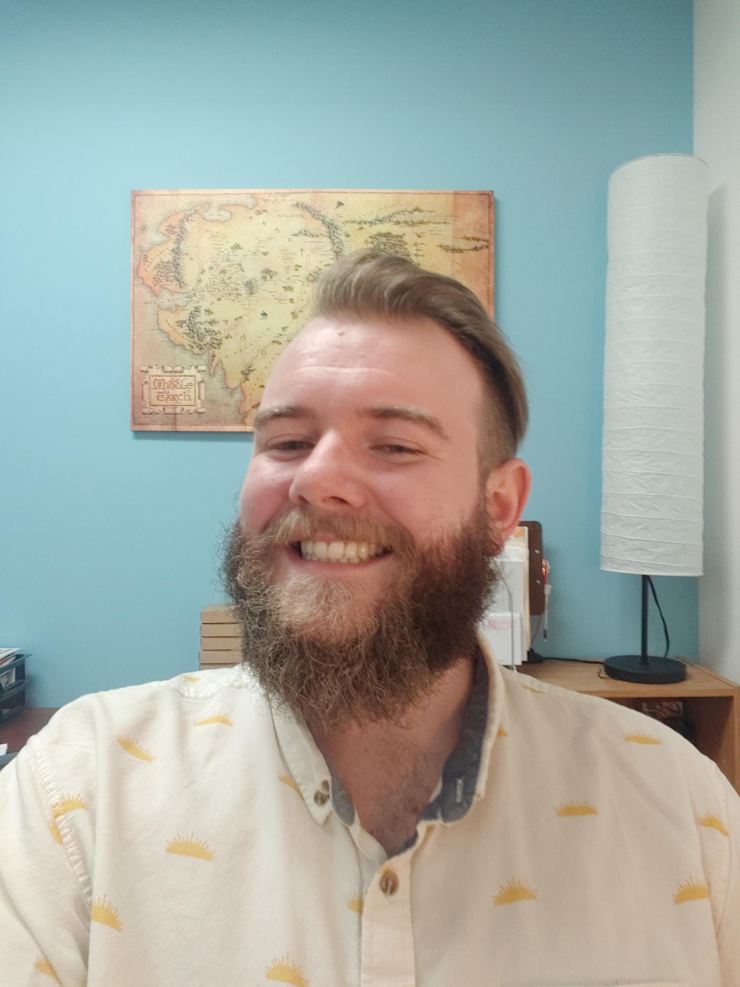
Most used emoji: 😎
If you could have one superpower, what would it be?
Telekinesis always seemed like the coolest superpower to have.What are you most grateful in life for?
Probably dogs, in general.Favorite place in Eugene:
I think I go to LevelUp more than any other place.Top 5 favorite movies:
Synecdoche, New York
The Nice Guys
There Will Be Blood
Being John Malkovich
Children of MenFavorite Meal:
I found this recipe for Vegan Chic-fil-A sandwiches, it is my favorite meal. A ton of work to make the seitan and fry the patties, but so worth it.Top 3 Music Albums:
ATLiens by Outkast
Uknowwhatimsaying¿ by Danny Brown
R.A.P. Music by Killer MikeFavorite Book:
It’s gotta be something by John Steinbeck, and I’m currently rereading East of Eden, so I’m going to pick that.Fun Fact:
I biked 750 miles from Eugene to San Francisco, in two weeks, last summer.Bio: Andrew was born in Colorado and went to college in Ithaca, New York where he got his Bachelor of Arts in Sociology with a minor in English. When he moved to Eugene, he began to work at ShelterCare as a receptionist, which he did for 1 ½ years. Andrew then moved behind the scenes to Administrative Assistant and was recently promoted to a full time Executive Assistant. Now, he leads the receptionists and utilizes his first-hand receptionist knowledge to support his team. Andrew maintains schedules while also administering performance reviews and providing emotional and practical support. Andrew enjoys supporting his team in the best way possible, and being able to make changes that he wanted to make while he was a receptionist.
-
The ShelterCare Receptionist Team


Here at ShelterCare, we can say with confidence that the receptionist team are everyday-heroes. They are the touch point between people in crisis and life-changing resources. The receptionists possess knowledge of the entire organization, what each program does and provides, and funnels people where they need to go. Not only do they know ShelterCare to the core, they are fluent in resources around the county. It is common for callers to need services which ShelterCare does not provide, so they direct people to the Centralized Waitlist, domestic abuse shelters, basic needs providers, and more. The receptionist is often that first friendly face, or voice, one experiences on their journey towards recovery, safety, and stability.
Additionally, ShelterCare receptionists embody everyday-heroism through their attitude and treatment of others, especially for those going through difficult times.They receive many calls a day from people experiencing a range of deep emotions. People call in tears, voices cracking as they ask for help during a desperate moment; other times, frustration boils over at the injustice and difficulty of their situation, they raise their voices in anger. Receptionists possess a certain strength, always practicing respect, empathy, and care which every person deserves.
For us, employees at ShelterCare, the receptionists do so much to keep the office running smoothly. The receptionists juggle multi-line phone calls, transferring calls all over the organization. Often, they act as investigators, inquiring about a caller’s needs with directed questions, and then making decisions as to where the call should go. It requires quick thinking and problem solving skills. Without them, ShelterCare’s gears would get jammed and we wouldn’t be able to move forward on our mission.
The front lobby is the receptionists realm, their kingdom, and they make it welcoming for all. Everyday, they carefully organize the front desk so all informational sheets are neatly stacked, the basket of goodies is fully stocked, and the coffee is warm and ready. The lobby coffee is always very popular. Receptionists keep the lobby spiffy-clean with consistent use of wet-wipes across the desk and chairs and Windex to the glass-front doors. The ShelterCare lobby does well to reflect ShelterCare’s organizational values. It’s nice for employees to know a friendly presence will be there as we come and go, throughout our day.
From the bottom of our hearts, thank you receptionists for all you do. Your daily dedication to positivity, support, and ShelterCare’s mission make a difference for people in need, consumers, and employees. Thank you receptionists for being everyday-heroes.
-
Michelle’s Corner: The Waiting Game

5.19.20
One of the most frustrating and possibly frightening phrases in the world of social service is “Wait List,” partly because the process of getting onto a wait list and then how to get served is confusing or misunderstood. There are many wait lists out there for just about any service, but the common factor is that the person on the wait list is in desperate need for something that is vital for that person’s safety and/or security.
If you are desperate for something, it is extremely hard—if not impossible–to be patient, and a wait list by definition means you have to…wait.
Stable housing is the bedrock for providing an individual or family security. I think all of us can agree that there are far too many people who need help in getting housing, especially as we see tents lining boulevards and parks in our community. It’s heartbreaking for ShelterCare staff who come to work every day, committed to helping people find and then KEEP safe housing to know that for every person served, another five names are added to the wait list.
ShelterCare is part of a group of agencies that work together with Lane County, drawing referrals from a coordinated wait list of individuals and families that have been identified as in need of permanent supportive housing. This list is not ranked by first come, first served, but rather by vulnerability and risk which is why individuals must go through an assessment every six months. While no system is perfect, it is a method we use to try to work together to avoid duplicating our services. Each agency has its strengths: for example, St. Vincent de Paul excels at serving our veteran population, and 15th Night does amazing work for homeless youth.
ShelterCare focuses on permanent supported housing for our most vulnerable populations who have mental health and medical health challenges. These consumers have very specific needs in finding housing that our housing specialists and case workers address in partnership with their clients.
In a perfect world, when we receive a referral, that person can immediately be matched with an available housing unit that fits their needs and budget. We do not have a perfect world. Available, affordable apartment units are scarce—and yes, most of our housing programs do require our consumers to pay at least a portion of the rent based upon their income—housing isn’t “free.” Additionally, our clients may have physical needs that require accommodation such as a person with a walker would need a first-floor unit.
It can take weeks if not months for an appropriate apartment unit to become available, and then our consumer must go through the landlord’s competitive application process and ensure that all documents are in order. Meanwhile, the wait list grows and people become disheartened, frustrated and even more afraid.
So what can we do? What’s the solution?
We all agree that it’s going to require our whole community to be part of it: nonprofits, governments, business leaders, landlords, neighbors, community members AND our unhoused community. Some of it has already started as we sit down together and talk about misconceptions, barriers and challenges. I’m impressed by how many groups are communicating and searching for ways to work together!
Additional affordable housing, not just for those facing poverty but for families finding themselves outpriced in an expensive housing market and seniors who are the fastest growing population of unhoused, is vital. Community education around how businesses and churches can be part of the solution and match up with agencies who need their support is crucial. And that’s just a portion of what needs to be in place.
Let’s be clear: this isn’t going to be easy—in fact, it’s going to be extremely difficult. This issue is not going to be “fixed” overnight or even in several months, but every journey starts with a first, brave step.
-
Michelle’s Corner: Try, Try Again

If anyone tells me they’ve never failed, I tend to assume one of two things: Either that he or she is lying to me OR that he or she has never lived in the real world. To be human is to make mistakes, fall down, and try again.
Think about it. How many times did you fall down as a toddler before you managed your first steps? How many times did you have to push off on your bike before you were able to ride without training wheels? If you play an instrument, how many hours did you practice before you got a piece just right? If you enjoy video games, did you get to the top level your first time playing?
And those are just simple things we enjoy doing. The hard stuff in life takes even more work to be successful. Our failures are a part of our personal stories, they help define who we are and why we make the choices we do.
A quick Google search led me to hundreds of famous quotes about failure. The one I’ll share with you was said by J.K. Rowling, author of the Harry Potter series. Her story is that she was a unemployed, single mother on welfare who had been turned down by twelve publishers. The 13th said yes and the rest, as they say, is history! She said, “Failure is so important. We speak about success all the time, but it is the ability to resist or use failure that often leads to greater success.”
We need to remind ourselves that failure is a fact of life and accept it as part of growing and learning. We need to forgive ourselves for our mistakes but also give grace to those around us who are trying so hard to learn new skills as well then celebrate when others achieve success.
The philosophy of failing towards success is key to ShelterCare programs. The consumers who our staff work with each day are all striving towards learning how to not only cope in our community, but to be part of it in a meaningful way. Each participant in our programs has a unique story filled with challenges they have overcome or are on their way to overcome. When a consumer enters our program, we have a no barrier philosophy for housing first, meaning that we believe that the first step to overcoming those challenges to have a safe place to live.
Just like everyone else, our consumers are going to sometimes fail in their journey towards a permanent housing situation. Like the children’s game of Chutes and Ladders where one minute you can climb to a new level, and the next find yourself back at the beginning, there will be false starts, mistakes, and second chances.
Success is falling down five times and getting back up six. It can be painful and slow and frustrating.
Oh, but that last time when a consumer reaches that success? That’s the best feeling in the world, and we all need to celebrate every single success. -
Voices: A Consumer Council Newsletter – Spring 2020


A newsletter featuring thoughts, art and poetry created by ShelterCare residents. Read the latest issue: Voices, Spring 2020
-
Michelle’s Corner: Being Connected

If there is ONE thing that the COVID-19 pandemic has brought into focus for all of us, it’s that being isolated from friends and family is mentally exhausting. While each of us have a different comfort level with being alone—perhaps we identify as an introvert, or we prefer to work in silence, or are simply comfortable being by ourselves—the need for at least some human contact is instinctive and healthy.
Our new normal of social distancing, and staying at home to keep ourselves and others safe from this frightening illness, has many ripple effects through our lives. Children have lost contact with friends from school, workers can’t chat around the water cooler about what happened over the weekend, grandparents can’t hug grandchildren. Some of these relationships we took for granted and, now that they’re gone, we realize how important they are in our day to day lives.
We’ve turned to technology to keep those relationships alive in some form or fashion. I know I’m on teleconference calls with “Brady Bunch” screens for hours a day with coworkers or community partners, but I’d prefer that to email chains. Not that emails aren’t a valid form of communication, but I need to see faces and read expressions as much as words, hear voices and read tones as much as read capitalizations to get emotions. I need to feel CONNECTED.
Technology has become vital to that human need for connection, and many necessary medical services have turned to telehealth to provide everything from diagnosis for an illness to mental health treatments. Patients and medical professionals are able to stay physically safe while being able to communicate and deal with problems before they grow into something that requires a visit to the ER.
ShelterCare has been able to quickly pivot to telehealth as a tool to get therapy, skills training and case management to our consumers who have needs even if there is a pandemic going on. Our partners, such as Trillium and PacificSource, have been with us as we have found innovative ways to reach those who need us most safely. They’ve been quick to find solutions to unexpected barriers to telehealth, such as PacificSource providing solar chargers for our unhoused clients who have nowhere to recharge their phones. Oregon Health Authority has relaxed Medicaid rules around telehealth to make this form of care more accessible to vulnerable populations.
Still, access to healthcare is becoming synonymous with access to technology which highlights yet another reason why poverty creates medical inequities. A person may have insurance through Medicaid, but still no healthcare without a phone, wifi, a data plan with enough minutes for a therapy session, a way to plug in a cellphone, or a place to talk privately with a healthcare provider. A visit to the ER, hospital stay, or even jail may have been avoided completely if the patient had been able to get help via a telephone prior to the mental health crisis.
Without access to technology, a person is not only physically isolated but MENTALLY isolated from any form of support be it through telehealth or just talking to a friend. Without access to technology, there is no social media, no education, no way to safely order goods online, an no CONNECTION to the world.
The pandemic won’t last forever, but what lessons will we have learned that we must take with us? Technology as a connector is certainly one of them. Access to technology is something that we will have to address as we look at the inequities that face the members of our community. I look forward to working with businesses, nonprofits and other agencies in looking for solutions.

Hope is Here
499 W 4th Ave, Eugene, OR 97401
541-686-1262
scadmin@sheltercare.org
Monday - Friday 8:30 AM - 4:30 PM