-
ShelterCare’s “Run for Your Life” 5k Fundraiser!

Save the Date and prepare to Run for Your Life! On October 19th, ShelterCare will be partnering with Thrill the World Eugene to host a zombie-themed 5k with 100+ zombies hidden around the Alton Baker race course!
Help us spread the word by following the event on Facebook and inviting your friends HERE!


We are currently seeking sponsorships! Last year’s race had 350 runners and over 100 volunteers!

Title Sponsor:

Thriller Level: 


Undead Level: 


Shambler Level: 


-
Creating Hospital Discharge Solutions for The Unhoused and Medically Fragile

About the Author:
Chris Cunningham recently completed her five-year term as a ShelterCare board member, serving as the board liaison with the agency’s program participants. She continues to participate as a member of the ShelterCare Public Relations committee, and also is a participant with NAMI’s (National Alliance on Mental Illness) Statewide Policy Advocates.
Nowhere to Go
Bill remembers limping after injuring his left foot, but he certainly wasn’t thinking the worst. The pain continued, and he learned he had a broken toe, and to complicate matters, diabetes. PeaceHealth Riverbend quickly scheduled his surgery to amputate three toes.
The 55-year-old man had recently moved back to Oregon from Georgia, where he had been working part-time in a restaurant and caring for his elderly parents during COVID. He attributes his diabetes to the sugary soda pop he drank in large quantities at his workplace, but he figured it was a better alternative than the large amounts of alcohol on which he had become reliant.
When Bill returned to Eugene, he had nowhere to go and ended up living with an acquaintance. However, he didn’t want to burden him while he was recovering from surgery. So, the social worker at PeaceHealth Riverbend wrote a discharge plan for Bill to stay in a pallet shelter encampment at St. Vincent de Paul on Highway 99.
It’s hard to imagine being discharged from a hospital with nowhere to go, especially when our local social safety net for people who are homeless is fragile. ShelterCare recognized this gaping hole in the healthcare continuum in 2013 and ever since has been providing post-hospital recuperation to people who are medically fragile and unhoused.
While the temporary shelter was safer than the streets, Bill said maintaining a diabetic diet and caring for his surgical wounds was next to impossible. Once a chef, who prepared healthy vegetarian meals at venues like Breitenbush Hot Springs, Bill knew he needed to adopt a diabetic diet as well as dress his surgical wounds. But he didn’t have ready access to a kitchen and running water.
Because Bill was able to walk, bathe himself, administer his own medications, and was eligible for the Oregon Health Plan, he was approved for a room at ShelterCare’s Medical Recuperation Program (SMR) on Highway 99. Each unit has a shower and toilet, a small sitting area, and a microwave and refrigerator. ShelterCare’s 18-bed program is funded primarily by PacificSource and Trillium, both Coordinated Care Organizations for Oregon Health Plan consumers.
Located in a repurposed hotel in West Eugene, ShelterCare’s SMR program has provided Bill, since early 2023, with a warm room, three cooked meals a day, transportation, and case management to help him heal and eventually transition to permanent housing. A visiting nurse stops by to change the dressings on his foot. Bill hopes that access to all these services will strengthen him enough for future employment.
The SMR program staff have also helped Bill establish a relationship with a primary care physician (PCP), who monitors his medications and who early on referred him for physical and occupational therapy, and mental health services. Bill’s fragile condition and acute medical needs have warranted a far longer stay than the average of 60 days, requiring his physician and insurance provider to approve extensions every month.
ShelterCare Provides a Healing Place Post-Hospitalization
Scott Eastman, Short-Term Housing manager at ShelterCare, says about 30 percent of SMR’s participants are on diabetic diets, the result of not having access to nourishing foods, healthcare, and medicine. What’s more, from May 2022 to May 2023, 49 percent of SMR participants had three or more concurrent medical conditions post-hospitalization, including mental health and chronic health issues, substance use disorders, and physical disabilities.
SMR provides case management to facilitate longer-lasting solutions to its participants, including long-term housing. While such efforts don’t guarantee a perfect ending for everyone, some 68 percent of the program’s participants transition to more permanent housing arrangements. “We want to increase their options when they leave,” Eastman says.
“It’s taken a lot of time to fine-tune the process,” Eastman admits. But the care SMR has taken to create collaborative relationships with local hospitals and insurers has paid off. “Insurers love us because we provide care at a fraction of the cost of hospital care,” he says.
Eastman says there are hidden costs involved in not providing care to people who are unhoused and discharged from the hospital or emergency room. Without post-hospital care, many are readmitted to the hospital, make frequent visits to emergency departments, and experience poor health outcomes—defined as shorter life expectancy, greater use of acute hospital services, and higher mortality and morbidity.
Sadly, across the country, many hospitals do not have policies that adequately address post-discharge challenges for people who are unhoused. Research shows that most people who are homeless are discharged to emergency shelters or to the streets. With few options, it is difficult if not impossible to clean wounds, prevent infections, get restorative sleep, and eat nutritious meals.
Housing is Healthcare
Bill is one of thousands of unhoused people who can’t rely on a safety net after an acute medical episode.
Research published by the National Center for Biotechnology Information notes an increase in hospitalizations among the unhoused population. Although the reasons for the increase are not known, speculation suggests that an aging homeless population and a lack of access to preventive care may be two contributing factors.
Recent legislation in Oregon emerged following the death of a Salem woman who didn’t have a place to go after her discharge in winter, 2022. Seeking a change in the current state system are three Oregon elected officials: Senator Deb Patterson, a Democrat from Salem, Senator Kayse Jama, a Democrat from Portland, and Representative Paul Evans, a Democrat from Monmouth. This year, the senators introduced Senate Bill 1076 which would require hospitals to have specific procedures for the discharge of homeless patients.
The bill received mixed support, Patterson writes, but a broad coalition supports another bill, SB 1079, that has established a Joint Task Force on Hospital Discharge Challenges to address the issues that hospitals face when trying to discharge patients to appropriate post-acute care settings. A broad coalition of stakeholders, including the Oregon Association of Hospitals and Health Associations, supports SB 1079, which has until November 1, 2023, to submit administrative changes to the governor that do not require legislative actions.
According to the National Institute for Medical Respite Care, SMR’s program is one of two programs in Oregon—the other is in Portland—that provides safe emergency shelter for people who are experiencing homelessness and have been discharged from the hospital following an acute medical episode that necessitates additional time and care to heal. Across the country, some states do not have any post-discharge options, typically referred to as medical respite, medical recovery, or medical recuperation programs, and offer varying services. In the meantime, SMR will do what it can to assuage the conditions for unhoused people, like Bill, who are leaving hospitals in Eugene/Springfield, and to provide an environment that lends itself to improved health outcomes and enhanced well-being. Bill grants that his extended SMR stay has played a significant role in his healing. “I’m grateful for the ShelterCare program,” Bill says.
-
Michelle’s Vlog: A Year in Review
To close out this fiscal year, ShelterCare CEO Michelle Hankes reflects on what we’ve accomplished and what still needs to be done.
-
A Compassionate Approach to Property Management


“I think we (ShelterCare) get to address tenants with a level of compassion you won’t find elsewhere,” says Amanda, ShelterCare’s Property Manager. “I’m not just evicting people immediately. In a traditional setting, if you’re a week past your rent, they’re starting to file eviction on you. What I like about ShelterCare is that we’re able to give tenants a little more time to figure it out…the support I have from the staff means we get to do a lot of skill building stuff that gets people through really tight spots,” explains Amanda.
ShelterCare’s Property Management program, run by Amanda, responds to tenant and neighborhood complaints, working to resolve issues swiftly by communicating with support staff to intervene. Staff assist the tenant in making efforts to modify the behaviors that pose a risk to their housing. Amanda works to identify when a tenancy is not a good match for the property/community and begins to search for alternative housing ahead of any eviction date. She also conducts regularly scheduled home inspections to ensure lease compliance and to help our program participants remain housed.
A big part of the process is the partnership between Amanda and our case managers, she explains, “every document I send to a program participant, their case manager sees it so they can support them through whatever it is. It might be a notice that feels scary because they might think their housing is being threatened.”It is Amanda’s goal to help our program participants feel as stable in their housing as possible. One strategy is to mitigate the panic that can come with serving a notice to a tenant, “I’ve literally had people tell me, “I got your notice and I’m packing to move out,” and I’m like, “No, I’m just letting you know you can’t store your barbeque on the porch, you don’t have to move out!” That zero to 100 panic is what we try to backpedal. I want people to take the notices seriously, but I want staff to support them so they are able to make good choices and not panic because that spirals really fast.”
It is common for those that Amanda works with to feel like their housing is not permanent due to trauma. She explains how she continuously works to encourage and support them through these feelings, “they think it’s going to be gone tomorrow and they’ve gotten used to sleeping outside, so they say, “I’m not setting my bed up, I’m not turning my heat on, I’m not unpacking my bags. I’m sleeping on the floor.” I have to tell them, “you’ve been here a year!” It doesn’t matter how long, they are worried it will get taken away from them twice.”
Amanda comes from a long background of property management, “I did property management for about 15 years in the private industry,” she says, “It was never as rewarding…it never felt like something I wanted to make a career out of.” She was looking for a career change that would make a difference, “I wanted to work with unhoused people, I didn’t want to be a Property Manager anymore,” she explained, “I was getting to the point, while looking for jobs, where I thought I had to be a Property Manager since it’s in my skill set. Then this was the first one I applied for. I just wondered, “How did this happen?” I love it. I’ve been here ever since.”
Amanda has positively affected many ShelterCare program participants, such as John* in our Birch program. Birch offers transitional shelter and case management to divert people with serious mental health needs from jails and psychiatric hospitals. John* explained how Amanda treats tenants with compassion, “Amanda is a real comfortable person to rent from and to talk to. She is approachable. She shines with consideration.”
Amanda says being ShelterCare’s Property Manager isn’t always easy, but is worth it, “It’s a little bit of being the bad cop. Property Managers are never going to be anyone’s favorite, but the way I’m able to do it here feels so much better.” It’s the successes that keep her going each day, “I’ve been here three years now, so I’ve seen people who came into these programs so broken and so hopeless, thinking they can’t do it, and maybe they didn’t do it the first time, maybe they’ve moved three times, but now it’s sticking and they’re housed and they’re proud. I come here everyday to do that.”Amanda discussed how each person she works with has their own individual story and a big part of her job is to advocate on their behalf, “All of my participants are not criminals…I am breaking down those stereotypes every single day…nobody’s story is the same.”
She explained a couple of the biggest misconceptions about those she works with, “There are certainly people who, through homelessness, have gotten criminal charges, either through actually being homeless, like trespassing, or just in their time surviving on the streets. Maybe their criminal charges made them homeless. That exists, but everyone out there is not actively engaging in crime and they don’t all abuse drugs and, if they are struggling with addiction, that doesn’t make them bad people, or even bad tenants.”
ShelterCare’s Property Management program provides the support that helps over 200 people remain stably housed; approximately 85-90% remain housed after the first year. Your donation supports the work Amanda does to help our program participants maintain the independence and stability that comes with being a renter. Will you support ShelterCare by making a donation today? -
Bags & Brews Cornhole Tournament

-
Ronald’s Trek to Mental Health


ShelterCare Behavioral Health program participant, Ronald, grew up in the rural parts of Oregon where it is more difficult to find mental health services, “I’ve had insomnia my entire life, and the best solution I could get there (Klamath Falls) or in La Pine was “we got a phonebook (to read),” he explains, “Have you ever heard of a sleeping pill? They never notice if you have anxiety or depression…and they were the professionals.”
Ronald has been in Eugene now for 12 years, 11 of which he has been with ShelterCare, “I went to WhiteBird and was connected (to ShelterCare) by the therapist I was seeing there,” he explains about the referral process, “ShelterCare was the first program I got into after WhiteBird and I stayed with it because they were a really great support group for me.”
ShelterCare’s Behavioral Health program provides mental health treatment to individuals diagnosed with a mental health condition, including trauma disorders, which often are related to the trauma and stress of homelessness. Current services include individual and group therapy, skills training, case management, telehealth, and healthcare coordination.
Ronald explains how these multifaceted services have helped him, “I was with ShelterCare for a year before my social security started coming in, then they became my payee, which was useful because I am, and always have been, terrible at managing money. If it wasn’t for them (ShelterCare), I would have no money.”
ShelterCare’s therapy program has worked wonders for Ronald, “Unlike other therapists, she’s (Linet, his therapist) actually been able to break through to me, which is usually difficult. It usually takes a long time,” he says.
Ronald lives in his own apartment with his cat, “Her name is Sweet Pea. She’s a tortoise shell,” he says. Recently, there have been some issues with people blocking the entrance to the complex and loitering, “They were hanging out there overnight and not letting tenants in,” Ronald describes, “I have social anxiety, I don’t like being around people and I know other people there (his apartment complex) have the same problems.”
It can be extremely difficult for someone experiencing a mental disability to handle situations like this, but with the encouragement of Ronald’s therapist Linet, and his skills trainer, Lizzy, he says he found success speaking up for himself and other tenants, “I eventually went and talked to someone who worked on-site about doing some things that would probably help. I was able to connect with her…just reaching out like that is a stretch for me because usually, I don’t even want to leave my apartment. Since that time, they put up a fence and we now have locked gates!”
Linet has worked at ShelterCare for a total of 33 years. She says she sticks around because of the unique experiences she has each day and the support of her coworkers, “my favorite parts of working at ShelterCare are that we work as a team, and support each other in the work; and that there is never a dull moment, there is always something new to learn, something new to experience.”

M’Ress, One of Ronald’s Favorite Star Trek Characters Being stably housed and connected to the behavioral health services he needs allows Ronald the time and space to enjoy what he loves: watching science fiction, particularly Star Trek, with his cat! He excitedly explained, “I like science fiction – Star Trek, Star Wars, Babylon 5, Stargate…I watched Equinox part 1 and 2 (episodes from Star Trek: Voyager) before coming in today! I just found a Star Trek Channel on Pluto TV – not that I don’t own the originals on DVD, including the one you may never have seen: The Animated Series. It’s a classic! I particularly like M’Ress; she’s a cat woman!”
Ronald says he is thankful for what ShelterCare has done to help him, and many others, create a safe and stable life for themselves, “It (ShelterCare) has helped a lot of people. I think it would be good if the public knew more about what ShelterCare does for people who have been homeless and have mental issues to get them into housing, to get them off the streets, and to help them get on track.” Last year, ShelterCare helped over 1,800 individuals move forward on their journey toward housing stability and independence.
Like a true fan, Ronald says, in regards to his goal for the future, “Star Trek: Picard is out Wednesday, I’ll be watching that!”
You can make a difference in lives like Ronald’s. Support from a therapist like Linet has changed his life forever. Your donation will help us provide behavioral health services to more individuals and continue moving our program participants forward in personal growth. Will you support ShelterCare by making a donation today?
-
Letting Perfect Get in the Way of Progress


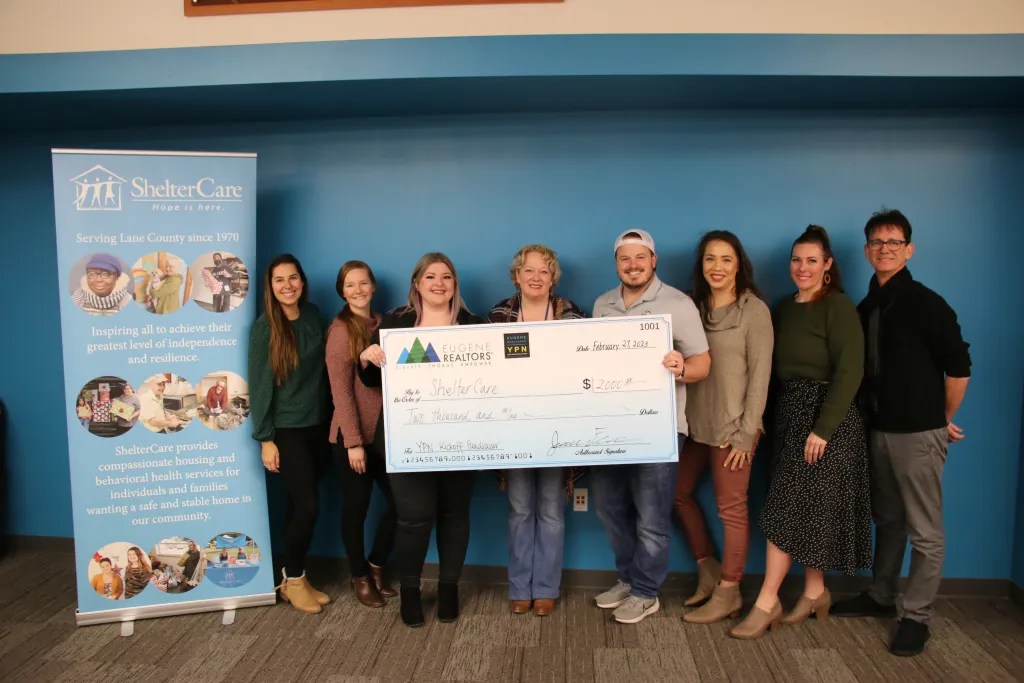

Michelle has been busy out in the community lately – see her above with a journalist from Germany, accepting a check from the Eugene Realtors, and at the Eugene Chamber of Commerce Celebration of business!
With the Governor’s recent executive orders recognizing homelessness as a state of emergency, there’s a mixed reaction of excitement that there is potential forward momentum in finding solutions and cynicism that the budget and policies being put forward won’t be enough to fix anything.
Admittedly, for those of us who have been working to address the needs of the unhoused for the past several years, we’re frustrated when we hear people say, “It’s about time someone does something.” Seriously? Walk a mile in our shoes! We also know how frustrating it is that, for every person we can help find and keep housing, there are ten more that we haven’t been able to serve. I heard one of my peers say the other day that even the $130 million proposed is just a drop in the bucket for what is needed for lasting results.
Hang on, everyone! This is where I’m going to start to preach.
Homelessness is a complex issue. In fact, I would argue that homelessness isn’t actually an issue but an outcome of the intersection of MANY other problems: poverty, housing scarcity, mental illness, trauma, climate change, addictions, access to education, discrimination, and so on. There’s no single, perfect, magic-wand solution that will “fix” homelessness. Because of that, it takes many different programs and agencies to focus on their expertise while collaborating with other agencies doing what they do best.
This complexity makes it look like homelessness isn’t being solved at all. But what you don’t see is that change is happening–sometimes one person or family at a time–as multiple, unique needs are being addressed.
I get it. We want to see change happen now. We want homelessness to be gone. Tomorrow.
Yet homelessness didn’t become a city (or state or even national) emergency overnight. All of those problems I mentioned before layered over themselves, year after year, as wages didn’t grow, available housing for all income levels didn’t expand, and capacity for healthcare didn’t keep up with need. Just to describe a few.
So what am I trying to say? I’m saying that every idea and every little bit of funding is important and that we can’t let finding the perfect solution get in the way of making any progress. Like the story where a child throws one starfish at a time back into the ocean and says she may not be able to help them all, what she is doing is important to the ones she can save. Being able to help those we can, should not be lost in our goal to reach everyone.
So I suggest we put aside our cynicism that there won’t be enough change, and focus on putting the strategies we do have into play because helping one person is better than helping no one.
Want to know more? Join ShelterCare on May 4th for a panel of experts answering questions on the local housing crisis! Click HERE to register.

-
A Home for the Holidays

ShelterCare CEO Michelle Hankes I usually like to keep my blogs positive, even if the themes and issues I discuss are scary, frustrating and concerning. I like to point out how you and I can help each other and our neighbors in a call to action, or highlight the wins our community has had in the areas of homelessness and behavioral health.
This month, I find myself typing and deleting several drafts of blogs that don’t follow my typical “can do” messaging.
Perhaps it’s because this holiday season has been more challenging than most due to economic uncertainty, staffing shortages, and a housing market that has reached crisis level in the Eugene area. These alone make running a nonprofit focused on getting people into permanent supported housing a daunting task to say the least.
But not impossible.
The staff at ShelterCare have done some tremendous work this past year. The Medical Recuperation program was able to double its capacity in serving homeless individuals coming out of the hospital, after major medical treatment (thanks to partners Trillium, PeaceHealth, and PacificSource.) The Rent Relief Program was able to get over six million dollars out to landlords and keep thousands of local people in their homes, all while passing an audit to prove every dollar was spent wisely. The Birch, .370 Aid and Assist, program successfully got individuals back on their feet through housing and case management, and was awarded a grant to expand the program to reduce recidivism.
Hundreds of individuals and families have become housed through the many other permanent supportive housing programs funded through state and local dollars. It’s also important that you know that other individuals, with severe and persistent mental illness, remain housed through the support of our behavioral health clinical staff who provide therapy and skills training.
And yet… It feels like we’re up against barriers out of our control. Affordable apartments don’t exist in our community. Homelessness is the top issue in every survey sent out to our community members, and there are two solutions that we can’t seem to talk about: making it easy to build affordable housing units and eliminating poverty through livable wages for every type of employment.
Bottom-line, let’s get people into homes and keep people from losing homes when they have a personal economic disaster such as a job loss or medical emergency.
How can YOU help? If you are a landlord (or know one), work with ShelterCare on our Masterlease program. We can guarantee you’ll receive rent payment on time and make a difference in a person’s life. Make a donation to ShelterCare that isn’t program specific so we can direct it to where it’s needed most. Advocate! Come to one of our Open Houses to learn more about us and tell your friends about us. I’ll meet anyone over coffee to talk about ShelterCare. The hardest questions are the best questions.
Together, hopefully next year, we’ll make sure many more people have a home for the holidays.
-
Krystal’s Story : From Homelessness to The Keystone


The Keystone program houses 15 of the most chronically homeless families, with kids, in Lane County. After years of homelessness, Krystal is part of one of these families. “I have loved being here at The Keystone,” Krystal says, “three years in a van was a long time to have such a little space and then a lot of space. It’s been a bumpy road, but I’m adjusting slowly.”
Krystal has two kids, “I have a 15 year old and an 11 year old. My son, who’s the 15-year-old, will eventually transition into living here with us. He lives with his best friend now,” she explains, “my daughter is still with her father, but hopefully moving forward, that will change. I couldn’t take care of myself, let alone them.”
Krystal is determined to become the best version of herself for her kids, “I’m trying to make it up now and prove to them, ‘I’ve got this, it’s okay.’”
Krystal has a long history with homelessness, “I have been homeless more often than I have not, my entire life,” she explains. Her most recent 3-year stint of homelessness began when she left her ex, “I came out of an 18 year abusive relationship with no credit, no rental history, no anything and without any of those things, no one’s giving you a chance. Thousands of dollars spent on application fees to just be told no. I worked a full-time job, most of that time, and still couldn’t afford to just survive. Rent is outrageously expensive here. It was every roadblock put in place just to have more.”
Krystal’s story is one of overcoming not only abuse and homelessness, but also managing mental illness, “I’m bipolar and had a complete mental breakdown and was reaching out for any kind of help. I happened to find somebody who said, “have you done a front door assessment?’” A front door assessment gathers information about a person including the barriers they face and characteristics that make them more vulnerable while homeless, to add them to the county managed Centralized Waitlist for getting into housing. Krystal said the process went quickly for her, “They did it that day. Next thing I know, I was getting a call from Lauryn.”
Lauryn is a Housing Specialist at ShelterCare’s Housing Services for Families program and spends most of her time at The Keystone. She explains that her favorite part of this job is seeing her client’s progress, “They come into this program, like Krystal, right off the streets. Watching them grow and be able to have a home and achieve things they never thought they could do is amazing.”
Lauryn is a big part of the network of support that ShelterCare program participants are provided with, “We always set up goals with them, when they move in, and we update them monthly,” she explains.
Now that Krystal is in stable housing with a network of support, she talks about what her personal goals look like moving forward, “Prioritizing my time for the things I need to is my biggest goal right now. Focussing on my health and continuing to put one foot in front of the other.” Krystal says that the staff at ShelterCare are a big part of her success, “They have kept me on track more than once. Without them, I would not be here and I would not be as okay as I am.”
Krystal now has more time and space for her favorite hobby, “me and my fiancé rock hunt and hand process everything, make jewelry out of it, then give it away. It’s a family activity.” Krystal jokes, “Our house is probably more rock than anything!”
Despite her struggles, Krystal wants to make the world a better place for others, “Three years being homeless has humbled me in a way I didn’t realize could happen. I found the love of my life and got to realize there’s something bigger out there that I want to do – I want to help people. I want to make sure other people know that they aren’t alone.” She even plans to host a community dinner for the holidays in her new home, “I’m doing an open door Christmas!” she exclaimed excitedly, “if you don’t have somewhere to go, my door will be open.”
You can make a difference in lives like Krystal’s. Support from a Housing Specialist like Lauryn and a stable place to live has changed both her and her children’s lives forever. Your donation will help us house more families and individuals before the next holiday season and continue moving our program participants forward in personal growth. Will you make a donation today to support ShelterCare’s work of providing housing and support services to chronically homeless families?
-
My Experience as a Development Intern

By Chloe Scheid

Chloe organizes materials for program participant move-in kits My name is Chloe and I am a junior at the University of Oregon working on my Bachelor of Arts. I am majoring in psychology and minoring in nonprofit administration. These interests led me to apply for an internship with ShelterCare. When I imagined what my future career might look like, I saw myself working at a nonprofit that increases access to mental health care. I really admired how ShelterCare contributes to this mission and brings safety and housing to those that need it most. I have spent the last 10 weeks interning with the Development department which is a small but mighty department responsible for all things fundraising as well an array of other projects. Development is what makes nonprofits run and I was thrilled to be a part of that.
Much of the work I get to do is the little details; but the little details are exactly what makes ShelterCare special. Every day is different. Some days I’m volunteering at the Run For Your Life zombie themed 5k and some days I’m addressing envelopes to express our gratitude to our donors. No task is insignificant to me.
However, some of the most rewarding work I’ve gotten to do is the big stuff. One of my favorite projects was helping to research and order items to make move-in kits for individuals and families moving into housing. I knew that everything I chose was an item that would become part of someone’s household and I knew how much that would mean to the people receiving it. After a spreadsheet of items was ordered, our office was soon filled to the brim with boxes not to mention the back of my car when I went to retrieve pick up orders (side note: certain retail locations get very confused when you pick up 14 toilet plungers!). Helping people on their journey to housing in this way really made me feel like I was making an impact in their lives.

The Development office in the midst of move-in kit organizing 
Another great project I got to be involved in was grant writing. I had taken one grant writing class at school but hadn’t yet gotten to use those skills in real life. It was incredibly valuable to be able to use those skills and build on them as I got feedback. I was able to work on a lot of practical writing skills that will help me in my future career. I also wrote a radio ad, many outreach emails, and several social media posts all of which I got feedback and edits on to improve my skills.
I was also able to connect with other staff members at ShelterCare and people from other nonprofits that gave me advice for my education and career that I would have never been able to get otherwise. This experience empowered me with knowledge and information about working in nonprofits as well as strengthened my skills and prepared me for a future career. I am so glad that I chose to apply at ShelterCare and that I was given the opportunity to help with so many diverse projects. I will take all of these skills and experiences with me through my education and career and ShelterCare will always have a place in my heart.

Hope is Here
499 W 4th Ave, Eugene, OR 97401
541-686-1262
scadmin@sheltercare.org
Monday - Friday 8:30 AM - 4:30 PM